What calf Botox targets
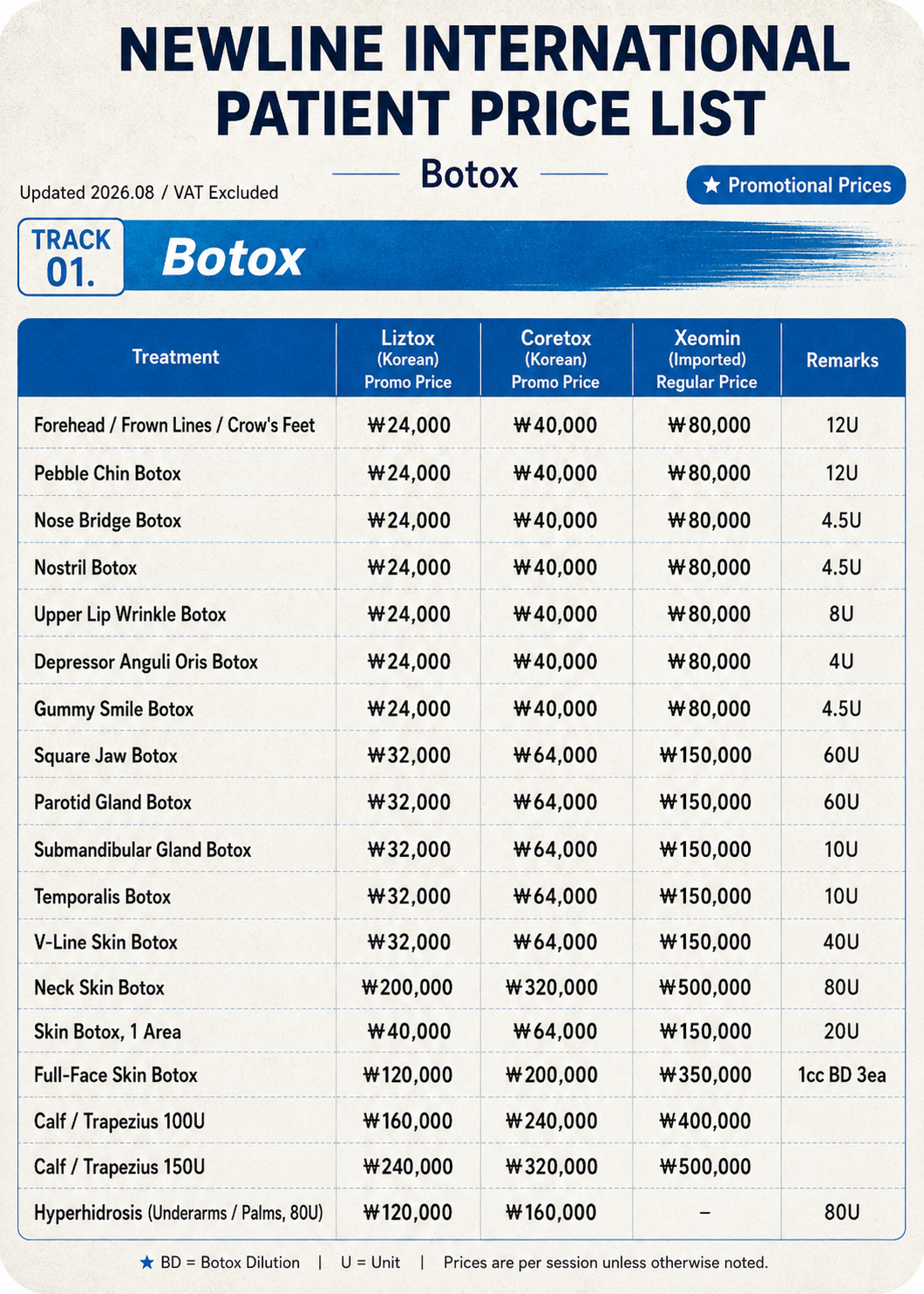
Calf Botox is a muscle-contouring treatment that focuses on calf muscle bulk rather than body fat, swelling or bone structure. Newline's source combines calf and trapezius Botox under 100U and 150U dose rows.
A patient with prominent gastrocnemius muscle may have a different treatment pathway from someone whose calf size is mostly related to fat or edema. The clinic should assess the leg while standing and moving rather than assuming that every large-looking calf is muscle-dominant.
100U and 150U pricing
Newline lists 100U at ₩160,000 with Liztox, ₩240,000 with Coretox and ₩400,000 with Xeomin. The 150U row is ₩240,000, ₩320,000 and ₩500,000. VAT is excluded according to the source material.
These are menu dose options, not a self-selection chart. Final dosing should consider muscle size, symmetry, previous toxin exposure and the patient's functional needs.
Calf Botox versus fat-reduction treatment
Botulinum toxin does not directly dissolve fat. If lower-leg volume is primarily soft tissue rather than muscle, calf Botox may not address the dominant cause. Similarly, swelling or vascular issues should not be treated as an aesthetic muscle problem without assessment.
This distinction protects both SEO quality and patient expectations. The page should rank for calf Botox while still explaining what Botox can and cannot change.
Walking, exercise and sports considerations
The calf muscles are important for walking, running, jumping and balance. Patients who train heavily, hike, dance or compete in sports should tell the clinician about their activity level before treatment.
International visitors should also consider walking volume during travel. Busan trips can involve substantial walking, stairs and luggage, so treatment timing should be planned with the clinic rather than chosen only around the lowest airfare or available appointment.
Why calf and trapezius pages should stay distinct
The source prices are shared, but the anatomy and functional implications are different. The calf page therefore emphasizes gait, exercise, leg contour and muscle-versus-fat assessment, while the trapezius page focuses on shoulder contour and upper-body function.
This content separation reduces cannibalization and gives search engines a clearer reason to index both long-tail pages.